Radiant Barriers in Hot Attics
Short answer
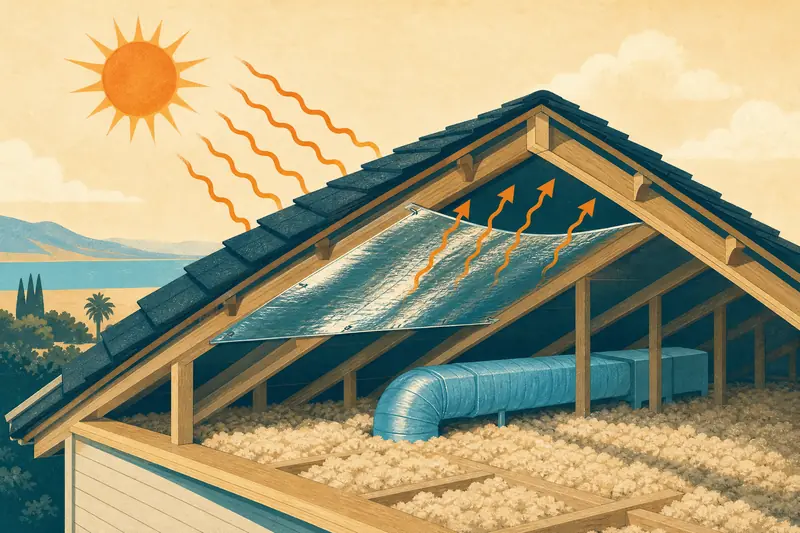
A radiant barrier is aluminum foil hung under the roof that stops about 95% of the heat a sun-baked roof radiates downward, trimming roughly 8–12% from annual cooling costs in hot climates.
Swelter Almanac, checked against the sources · updated
Points on this page
The forecast in brief
- An aluminum foil radiant barrier blocks 95% of the heat radiated down by the roof (FSEC).
- Expected savings: about 8–12% of cooling costs in hot climates (FSEC; DOE Building America).
- A field retrofit of 8 Florida homes measured about 9% less cooling energy and a 16% lower summer afternoon peak (FSEC-CR-1231-01).
- Hang it at the rafters, foil facing down into an airspace; sheet foil laid on the attic floor gathers dust and stops working (FSEC).
- In an attic already insulated to R-30 or better, there is little heat flow left to cut (FSEC).
- Ducts or an air handler in the attic make it pay more: Florida homes with attic air handlers used 30% more cooling energy (FSEC).
What does a radiant barrier do?
A radiant barrier stops the hot underside of a roof from beaming its heat down onto the insulation below. The Florida Solar Energy Center (FSEC) defines it as a layer of aluminum placed in an airspace between a heat-radiating surface, such as the roof deck, and a heat-absorbing one, such as attic insulation.
Foil works because it reflects thermal radiation well and gives off very little heat itself. That second property is the one people miss: FSEC's homeowner Q&A explains that single-sided foil still works facing down, because its low emissivity keeps it from radiating the roof's heat to the cooler insulation. In hot climates the roof surface itself can pass 160°F, according to a DOE Building America brief from PNNL, so there is plenty of radiant heat to block.
A radiant barrier does not seal anything. FSEC notes it need not be airtight, small tears barely matter, and continuous soffit-to-peak ventilation actually improves its performance. If you want to know how much vent area an attic should have, see attic ventilation in hot climates.
How much does a radiant barrier save?
Plan on about 8–12% of annual cooling costs in a hot climate. FSEC gives that range for the Southeast, and the PNNL brief for DOE Building America gives the same 8% to 12% for hot climates generally.
Measured results land inside that range. In an FSEC field study of 8 Central Florida homes, a radiant barrier retrofit cut cooling energy by 3.6 kWh a day, or about 9%, and lowered the summer afternoon peak by 420 watts, about 16%.
Be wary of bigger claims. FSEC's arithmetic: foil can cut heat gain through an R-19 ceiling by over 40%, but if the ceiling is only 20% of the cooling load, the whole-house saving is about 8%. In the typical 1,500-square-foot Central Florida home FSEC modeled, the attic and its ducts made up 22% of the cooling load, so no attic product can save more than that share.
Radiant barrier numbers
- 95%Heat radiated down by the roof that foil blocksFSEC
- 8–12%Annual cooling cost savings in hot climatesDOE Building America (PNNL)
- 9%Measured cooling energy cut in 8 Florida homesFSEC
- 420 WAverage drop in summer afternoon peak demandFSEC
Where should a radiant barrier go?
Put it at the roof, not on the floor: staple it to the underside of the rafters or truss top chords, or to the underside of the roof decking, with the foil facing down toward an airspace. FSEC calls this the most effective method for an existing attic and leaves a strip of one to two inches open at the peak and two to three inches above the insulation at the eaves.
In new construction or when a roof is being redecked, foil-faced roof sheathing puts the barrier in place with no extra labor. Rolling foil directly under new shingles does nothing, because foil only blocks radiant heat when it faces open air; pressed against the deck it simply conducts heat through.
| Location | What FSEC says |
|---|---|
| Under rafters or roof decking, foil down | Recommended for existing attics; stays dust-free |
| Foil-faced roof sheathing | Easiest in new homes and redecking |
| Sheet foil on top of insulation | Not recommended; dust builds up and moisture can condense |
| Radiant barrier "chips" on the attic floor | Acceptable; layered air pockets resist dust |
| Foil-faced batts flipped over | Not a good idea; dust and, with some glues, fire risk |
| Low-emissivity paint on the decking | Available, but not by definition a radiant barrier |
Attics are dangerous workplaces in summer. FSEC warns that attic daytime temperatures can rise far above 100°F across much of the Sunbelt year, so it suggests working early in the morning or waiting for cool weather, with a partner, stepping only on framing and never on the ceiling drywall. Staples should never go through or over wiring. Anyone who feels dizzy, sick or confused up there should get out and cool down; heat exhaustion and heat stroke signs are worth knowing before you climb the ladder.
When does a radiant barrier help least?
It helps least in an attic that is already heavily insulated. FSEC says a radiant barrier cuts heat flow from the attic into the house by roughly 40%, and in an attic insulated to R-30 or better there is very little heat flow left to reduce.
It also does little when it is installed wrong. Sheet foil lying on the insulation collects dust, and FSEC says that dust will eventually negate the barrier effect; FSEC also warns that moisture condensation problems can develop in any installation. Foil with no airspace in front of it (under shingles, for example) acts as a conductor rather than a barrier.
Climate matters too: the more of a household's energy bill goes to heating, the less a radiant barrier is worth. Long Sun Belt cooling seasons tilt the balance the other way.
The best payoff comes where ducts run through the attic. FSEC research found that ducts in hot attics can pick up more heat at peak than the well-insulated ceiling does, and that homes with the air handler in the attic used 30% more space cooling energy (FSEC-GP-171-00). Blocking roof radiation keeps those ducts in cooler air.
How does it compare with more insulation?
Insulation comes first, and a radiant barrier is a complement to it, not a substitute. ENERGY STAR's recommended attic R-values, based on the 2021 IECC, are R30 for an uninsulated attic in Zone 1 (South Florida) and R49 for an uninsulated attic in Zones 2 and 3, which cover most of the Gulf Coast, Texas and the Southwest; with 3–4 inches already in place, the targets are R25 and R38.
If your attic is well short of those levels, topping up insulation is usually the bigger step, and the radiant barrier adds less once the insulation is thick. If the insulation is already at R-30 or more, the barrier's main remaining job is keeping attic ducts and the air handler out of the worst radiant heat. FSEC lists three better ways to limit attic heat than powered attic fans: more insulation, a truss-mounted radiant barrier, or a white reflective roof, which is the subject of the cool roofs page.
Fix leaky ducts at the same time. ENERGY STAR says about 20 to 30 percent of the air moving through a typical duct system is lost through leaks and poor connections, and it calls for mastic sealant or metal tape rather than duct tape. For a bedroom floor that bakes every afternoon, the hot upstairs page walks through the attic, duct and airflow fixes together.
How this page was put together
This page draws on the Florida Solar Energy Center's radiant barrier Q&A (FSEC-EN-15, revised edition), FSEC's radiant barrier field monitoring report (FSEC-CR-1231-01) and attic research summary (FSEC-GP-171-00), the DOE Building America radiant barrier brief prepared by PNNL (2012), and ENERGY STAR's insulation and duct sealing pages based on the 2021 IECC, all read in October 2026. Left out: a DOE "5–10%" figure and an Oak Ridge savings range that could only be found on third-party copies, installed prices, and payback promises, which depend on local power rates.
More questions
Does a radiant barrier work in winter too?
It can trim a little heat loss on winter nights, but FSEC says the climates where it was tested have brief or no winters, so the heating effect has not been well shown. In heating-dominated climates it can even cost a little, because daytime attic heat is welcome in winter.
Should the shiny side face up or down?
Down, toward the attic air. FSEC explains that single-sided foil facing down still blocks the roof's heat because it barely radiates, and it stays free of dust over the life of the installation.
Will a radiant barrier overheat my shingles?
FSEC measured shingles above radiant barriers on hot summer days and found peaks only 2–5°F higher than without one. Shingles that normally reach 160–190°F at peak should not be harmed, though it is sensible to read your shingle warranty first.
Is a radiant barrier the same as reflective insulation?
Not quite. A radiant barrier is a low-emissivity foil facing an airspace; FSEC lists foil-faced insulation and multi-layer foil products as separate types, and says an R-value may be claimed only when the product was tested under federal (FTC) rules for insulation.
Can a radiant barrier replace a cool roof?
They attack the same heat at different points. A cool roof reflects sunlight before the roof heats up, while a radiant barrier stops the hot deck from radiating into the attic; FSEC names both, along with more insulation, as better ways to limit attic heat than powered attic fans.
Keep reading