Sizing a Room Air Conditioner
Short answer
What size air conditioner for a room? Measure the floor area, read the ENERGY STAR chart (5,000 BTU for 100 to 150 square feet), then adjust for sun, shade, occupants and kitchens.
Swelter Almanac, checked against the sources · updated

Points on this page
The forecast in brief
- ENERGY STAR's chart starts at 5,000 BTU per hour for 100 to 150 square feet and tops out at 34,000 BTU for 2,000 to 2,500 square feet (ENERGY STAR).
- Cut the figure by 10 percent for a heavily shaded room; add 10 percent for a very sunny one.
- Add 600 BTU for each person beyond two who regularly uses the room, and 4,000 BTU if the unit cools a kitchen.
- The chart assumes an 8-foot ceiling, so taller rooms need a closer look.
- - Room units are rated by CEER under ENERGY STAR Version 5.0, in effect since October 30, 2023.
What size air conditioner does a room need?
A room needs the capacity that matches its floor area on the ENERGY STAR sizing chart, read in October 2026. Measure in feet, turning inches into fractions (12 feet 6 inches is 12.5 feet), then multiply length by width. A triangular nook is length times width divided by two, and an L-shaped room is split into rectangles that you add together.
| Area to be cooled (sq ft) | Capacity needed (BTU per hour) |
|---|---|
| 100 up to 150 | 5,000 |
| 150 up to 250 | 6,000 |
| 250 up to 300 | 7,000 |
| 300 up to 350 | 8,000 |
| 350 up to 400 | 9,000 |
| 400 up to 450 | 10,000 |
| 450 up to 550 | 12,000 |
| 550 up to 700 | 14,000 |
| 700 up to 1,000 | 18,000 |
| 1,000 up to 1,200 | 21,000 |
| 1,200 up to 1,400 | 23,000 |
| 1,400 up to 1,500 | 24,000 |
| 1,500 up to 2,000 | 30,000 |
| 2,000 up to 2,500 | 34,000 |
The chart is the starting number, not the final one. ENERGY STAR then lists four adjustments, covered below, and notes that its capacities are worked out for an 8-foot ceiling. For a room with a vaulted or 10-foot ceiling, the page suggests looking at a larger unit but gives no formula, so treat that as a judgment call rather than a rule.
A 14-by-20-foot bedroom is 280 square feet, which lands in the 7,000 BTU row. That is the figure you carry into the adjustments.
How do sun and shade change the size?
Sun and shade move the chart number by 10 percent in either direction: reduce capacity by 10 percent for a heavily shaded room and increase it by 10 percent for a very sunny one (ENERGY STAR). In the 280-square-foot bedroom, a west wall that bakes all afternoon turns 7,000 BTU into 7,700. Under a dense oak on the Gulf Coast, the same room drops to 6,300.
Shade you add later counts too. The USDA Forest Service found that trees shading a home's west side produced the largest cooling savings of any placement, so a room that is "very sunny" today may not stay that way. Exterior shade, solar screens and low-SHGC glass are covered in window shading for heat.
What about kitchens and busy rooms?
Kitchens get a flat 4,000 BTU added, and busy rooms get 600 BTU for each regular occupant beyond two (ENERGY STAR). A 12-by-15-foot kitchen is 180 square feet, which reads 6,000 BTU on the chart; with the kitchen adjustment it becomes 10,000 BTU. A 280-square-foot family room where four people watch the game most evenings adds 1,200 BTU for the two extra people.
Stack the adjustments when more than one applies. Swelter Almanac applies the percentage first and then the flat additions, which is simple arithmetic and keeps the order consistent; ENERGY STAR does not say which order to use. Very sunny and four people in the bedroom example works out to 7,700 plus 1,200, or 8,900 BTU.
Units are sold in steps, so the result rarely matches a box exactly. Pick the size closest to your number rather than jumping a step or two higher "to be safe", for the reasons in the next section.
What goes wrong with an air conditioner that is too big?
An oversized room unit reaches its setpoint fast and stops running while the air is still wet, so the room feels cool, damp and clammy; ENERGY STAR adds that it costs more to buy and wastes energy (ENERGY STAR). That matters most in humid heat, where the EPA advises keeping indoor humidity below 60 percent and a clammy room in Houston or Tampa is the first sign of a unit that is too big.
The same problem shows up in central systems. A DOE Building America guide reports that short-cycling causes poor humidity control in humid climates and cites a Florida study where systems oversized by 50 percent or more used about 9 percent more cooling electricity. Those are central-system figures, not room-unit tests, but the physics is the same. If a room already feels sticky, see why an A/C stops dehumidifying.
What does a room air conditioner's efficiency label mean?
The efficiency number on a room unit is CEER, the combined energy efficiency ratio, and ENERGY STAR sets a minimum CEER by capacity, louvered or non-louvered sides, and reverse-cycle models (ENERGY STAR criteria). The current Version 5.0 specification took effect on October 30, 2023. Compare CEER only between units of the same size and style.
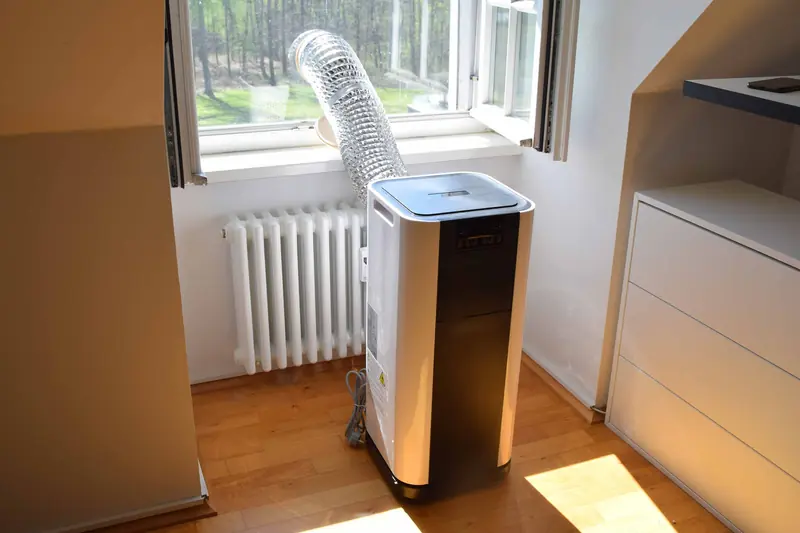
ENERGY STAR says the more efficient choices use variable-speed compressors, which slow down instead of switching hard on and off. Certified units also run an energy saver mode that limits the fan when the compressor stops, plus a filter reminder. U-shaped and saddle units straddle the sill so the window can still open and the noisy compressor sits outside.
Refrigerant is on the label too. ENERGY STAR lists R-32, R-454B and R-290 as lower global-warming options for room units. You never handle that refrigerant: a sealed room unit that stops cooling goes to a repair shop or gets replaced. If you're unsure, call a licensed technician.
How do you set up the unit once it is sized?
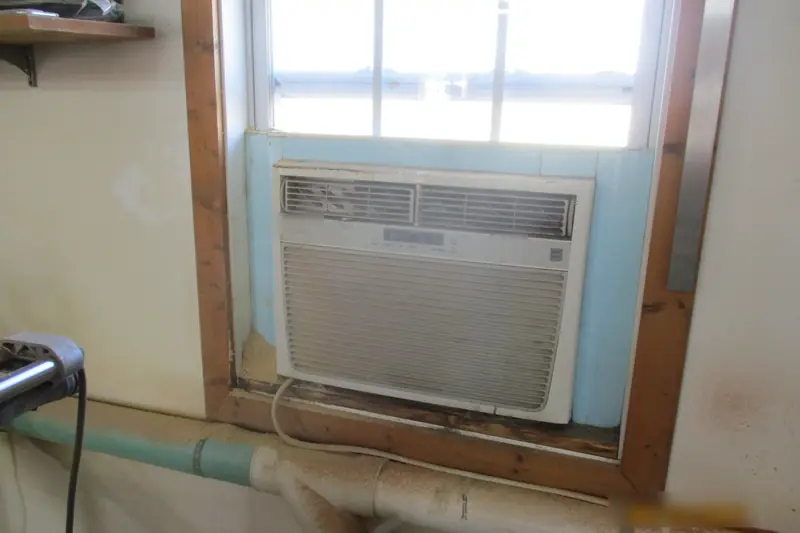
Set it up level and sealed, then run it at the warmest comfortable setting. ENERGY STAR notes that a poorly installed room unit leaks as much air as a 6-square-inch hole, so use the side panels and foam that come in the box and keep the cabinet level so condensate drains. For more on fitting either style, see portable vs window units.
ENERGY STAR suggests about 78°F as a typical comfortable setting, with a ceiling or box fan to spread the cool air; a fan lets you feel cooler at the same setting (see ceiling fan direction). On humid days, turn the unit's fan speed down so the coil pulls out more moisture.
When indoor air tops 90°F, fans stop being a safe main plan, per the CDC. If the room unit cannot keep up during a heat wave, go somewhere air-conditioned or dial 2-1-1 for a cooling center.
Room unit numbers
- 5,000 BTUSmallest chart size, 100 to 150 sq ftENERGY STAR
- 34,000 BTULargest chart size, 2,000 to 2,500 sq ftENERGY STAR
- 8 ftCeiling height the chart assumesENERGY STAR
- 9%Extra cooling electricity, central systems oversized 50%+DOE Building America
How this page was put together
This page is based on the ENERGY STAR room air conditioner page and its Version 5.0 key product criteria (effective 2023), a DOE Building America sizing guide, the USDA Forest Service tree-shade study and the CDC's page on heat and health; each was read in October 2026. The worked examples are plain arithmetic on the ENERGY STAR chart. Left out: per-capacity CEER minimums (the published table did not read cleanly), store prices and brand names, and any sizing rule of thumb without a primary source.
More questions
Is 5,000 BTU enough for a small bedroom?
For 100 to 150 square feet with an 8-foot ceiling, yes, by the ENERGY STAR chart. A very sunny west-facing bedroom would call for about 5,500 BTU, so the next size up is reasonable there. A shaded one stays at the smallest size.
Should you size up for a desert climate?
The ENERGY STAR chart has no climate adjustment, only the sunny, shaded, occupant and kitchen ones. In Phoenix or Las Vegas, apply the sunny-room 10 percent where it fits rather than inventing a bigger one. Leaky windows or a hot attic above are better fixed than oversized around.
Can one window unit cool two rooms?
Only if air moves freely between them, so size by the combined floor area and keep the doorway open. A closed door blocks most of the cool air. A fan in the doorway helps push it through.
Does a 12,000 BTU unit cool a 450-square-foot room faster than a 10,000?
It may pull the temperature down sooner, but it will also cycle off before drying the air. In humid heat, that leaves the room cool and sticky. The 10,000 BTU row is the ENERGY STAR match for 400 up to 450 square feet; 450 to 550 calls for 12,000.
What size does a garage or sunroom need?
Measure and read the chart the same way, then add 10 percent for a very sunny space. Glass rooms and uninsulated garages are not the typical rooms the chart has in mind. A mini-split sized by a contractor's load calculation may suit them better.
Keep reading