Whole-House Fans vs Attic Fans
Short answer
Whole house fan vs attic fan comes down to this: a whole-house fan pulls cool outdoor air through your rooms and out the attic, while a powered attic fan only vents the attic and rarely saves energy.
Swelter Almanac, checked against the sources · updated
Points on this page
The forecast in brief
- A whole-house fan draws outdoor air in through open windows and exhausts house air through the attic (DOE Building America, 1999).
- Size it at one-half to one times the house volume in cfm, and give the attic 1 square foot of net free vent area per 750 cfm (DOE).
- In a Florida test house, fan ventilation cooled rooms 3–6°F but pushed nighttime humidity from 74% to 83% (FSEC).
- In a Texas comparison, an attic ventilator used 284 W to save about 170 W of air conditioning (FSEC).
- Solar attic fans saved about 6% of cooling in Florida, with a payback over 20 years (FSEC).
- Open at least two windows before starting a whole-house fan; it can backdraft a gas water heater (DOE).
The two fans sit a few feet apart in the attic and get confused constantly, often by people selling one of them. They do opposite jobs. One moves the house's air; the other moves only the attic's, and the research on that second one is not kind.
What is the difference between a whole house fan and an attic fan?
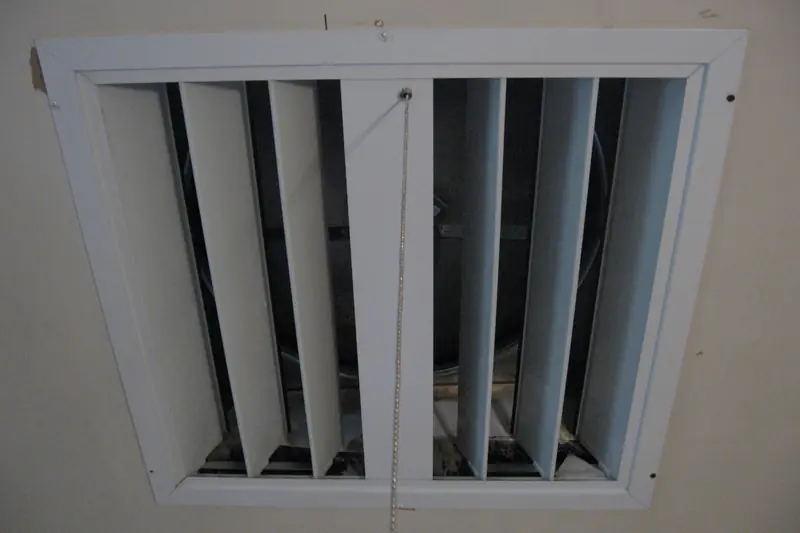
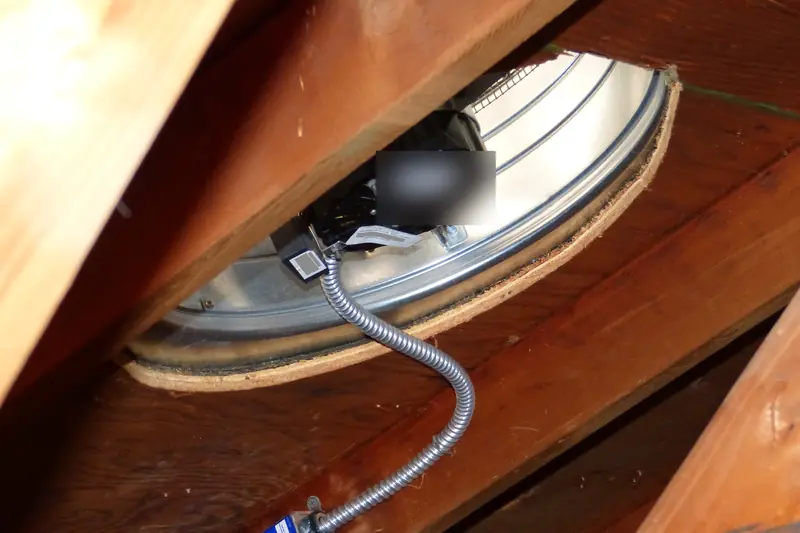
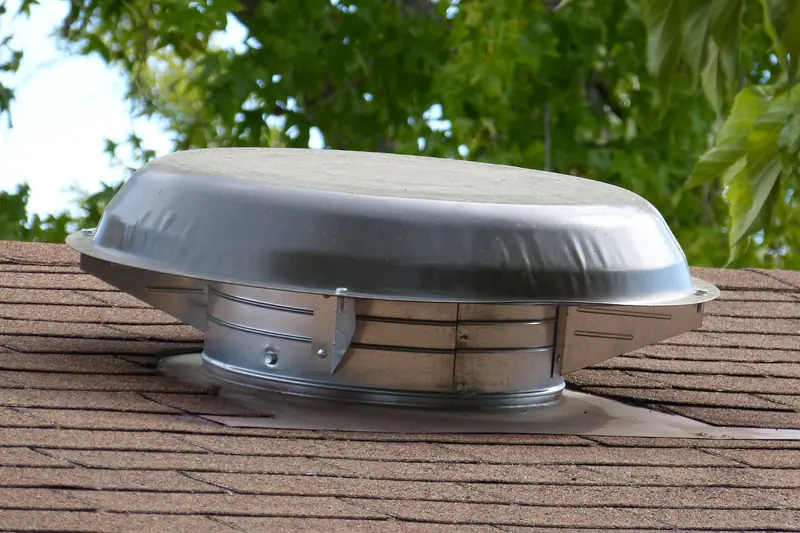
A whole-house fan sits in a ceiling between the living space and the attic and pulls air through the entire house; a powered attic fan sits in the roof or a gable and moves only attic air. The first can replace hot indoor air with cool night air. The second tries to cool the attic, which is a much weaker lever on the rooms below.
| Feature | Whole-house fan | Powered attic fan |
|---|---|---|
| Where it mounts | Hallway ceiling, opening into the attic | Roof deck or gable wall |
| Air it moves | Outdoor air through every open room | Attic air only |
| When it helps | Outside cooler than inside, dry air | Rarely; uninsulated attics |
| Measured result | 3–6°F cooler house in a Florida test | 284 W used to save about 170 W (Texas) |
| Main risk | Backdrafting gas appliances; humidity | Pulling conditioned air; depressurizing gas appliance areas |
How does a whole-house fan work?
A whole-house fan works by pulling cooler outdoor air in through open windows and pushing warm indoor air up through the attic and out its vents. The DOE Building America bulletin says it will cool a house whenever outdoor temperatures are below indoor ones, and that running it in the morning, late evening and at night also cools the walls, floors and furniture.
Sizing starts with volume. Multiply the house's square footage by its ceiling height, then choose a fan that delivers one-half to one times that number in cubic feet per minute at 0.1 inch of static pressure. A 1,500 square foot house with 8-foot ceilings holds 12,000 cubic feet, so DOE's rule points to roughly 6,000–12,000 cfm.
The attic has to let that air out. DOE calls for 1 square foot of net free vent area for every 750 cfm, so a 6,000 cfm fan needs about 8 square feet. Insect screens can cut a vent's net free area to about half its open area, so screened vents may need twice the size. DOE's example fan moved 4,500 cfm on high at 240 W and 3,200 cfm on low at 120 W.
Where does a whole-house fan pay off?
A whole-house fan pays off in dry climates with cool nights, such as the desert Southwest and high, dry West Texas, and only in spring and fall in humid places. Swelter Almanac recommends it for that dry-climate case and not for Florida, the Gulf Coast or humid East Texas summers.
The humid-climate case is clear in FSEC's natural ventilation research. Fan-powered night ventilation at a Cocoa Beach test house brought indoor temperatures down 3–6°F, but the relative humidity indoors went from 74% up to 83% over the ventilated nights. In Orlando, only 63 summer hours, about 2%, were below 78°F and under 70% humidity at once.
Even in houses with A/C, DOE's bulletin suggests seasonal use in spring and fall may give the best balance of comfort and cost. The night flushing page explains how to run the routine hour by hour, and the dry heat section covers pairing it with evaporative cooling.
Is a powered attic fan worth the electricity?
A powered attic fan is generally not worth the electricity, and Swelter Almanac does not recommend them. FSEC's attic ventilation review found the one controlled examination showed fan electricity exceeding the air conditioning savings: in a Texas side-by-side test, about 170 W of cooling saved against 284 W drawn by the fan.
FSEC's conclusion is that powered vents do not typically produce net savings unless the attic is uninsulated. Solar-powered attic fans avoid the electric bill but saved about 6% of cooling energy in Florida, with a payback FSEC called not very favorable at over twenty years.
There is also a pressure problem. A 2005 FSEC review of attic-venting research adds that powered ventilation can suck cooled house air up through ceiling leaks and lower the pressure around fuel-burning appliances, which FSEC calls potentially dangerous. FSEC lists better ways to limit attic heat: more attic insulation, a radiant barrier fixed to the trusses, or a white reflective roof.
What are the safety rules for a whole-house fan?
The first rule is to open windows before you switch on a whole-house fan; DOE says to open at least two or more. Without open windows, the fan pulls air from wherever it can, including down a water heater flue or fireplace chimney.
DOE warns that a whole-house fan may easily backdraft a water heater in a louvered closet, and the EPA lists back-drafting from furnaces, gas water heaters, wood stoves and fireplaces as a source of carbon monoxide. Sealed-combustion or direct-vent appliances avoid that risk. Fit carbon monoxide alarms with battery backup on every level, as Ready.gov advises, and if one sounds, get outside, then call 911.
DOE also says to caulk all penetrations between the attic and living space, so the fan draws through windows rather than through light fixtures and gaps. Have the fan wired and its circuit installed by a licensed electrician; working near the attic opening, the gas appliances or the breaker panel is not a weekend project. If you're unsure, call a licensed technician.
Last, mind the weather: close the windows and switch the fan off once the outdoor air is warmer than indoors, or when outdoor humidity climbs. On smoky or high-pollen nights, a fan that pulls outside air through the house is the wrong tool.
Whole-house and attic fans
- 750 cfmFan airflow per square foot of attic net free vent areaDOE Building America
- 240 WDraw of a 4,500 cfm whole-house fan on highDOE Building America
- 83%Indoor night humidity during fan ventilation, FloridaFSEC
- 284 WAttic fan draw in a test saving about 170 W of coolingFSEC
For heat-wave nights when nothing outside is cool, a fan of any kind is the wrong answer above 90°F indoors; the heat safety section explains why and where to go instead. The Moving air hub lists the rest of this section.
How this page was put together
This page draws on DOE Building America's whole-house fan bulletin (DOE/GO-10099-745, 1999), FSEC's report on natural ventilation in Florida homes (1992), FSEC's attic ventilation research summary (2000), a 2005 FSEC review of attic-venting studies, and the EPA and Ready.gov carbon monoxide guidance, each read in October 2026. The DOE Energy Saver web page on whole-house fans was offline, so its climate wording is not quoted. Prices, noise ratings and brand comparisons were left out.
More questions
Can a whole-house fan replace air conditioning?
In a dry climate with cool nights, it can carry spring and fall and shorten the A/C season. In humid summers it cannot, because outdoor air is rarely cool and dry at the same time.
Does a house with a whole-house fan also need an attic fan?
No. The whole-house fan already pushes air out through the attic; what it needs is enough attic vent area, about 1 square foot of net free area per 750 cfm, per DOE.
Should the A/C run while the whole-house fan is on?
No. The fan pulls outdoor air through the house, so running both sends cooled air straight out the attic. Switch one off before starting the other.
How many windows should be open?
At least two, per DOE, and more is better for even airflow. Open windows in the rooms you want cooled and keep gas appliance closets well away from the airflow path.
Are solar attic fans worth it?
FSEC measured about 6% cooling savings in Florida and a payback of more than 20 years. A radiant barrier or more insulation is usually the better spend.
Does a whole-house fan help in a Texas summer?
In dry, high West Texas, often on summer nights. Along the humid Gulf Coast and in East Texas, it is mainly a spring and fall tool.
Related pages

Back to every section of the almanac