Swamp Coolers vs Air Conditioners
Short answer
Swamp cooler vs air conditioner comes down to humidity: in dry desert air a cooler can deliver low-70s air on a fraction of the power, but in muggy weather only refrigerated A/C keeps a house comfortable.
Swelter Almanac, checked against the sources · updated
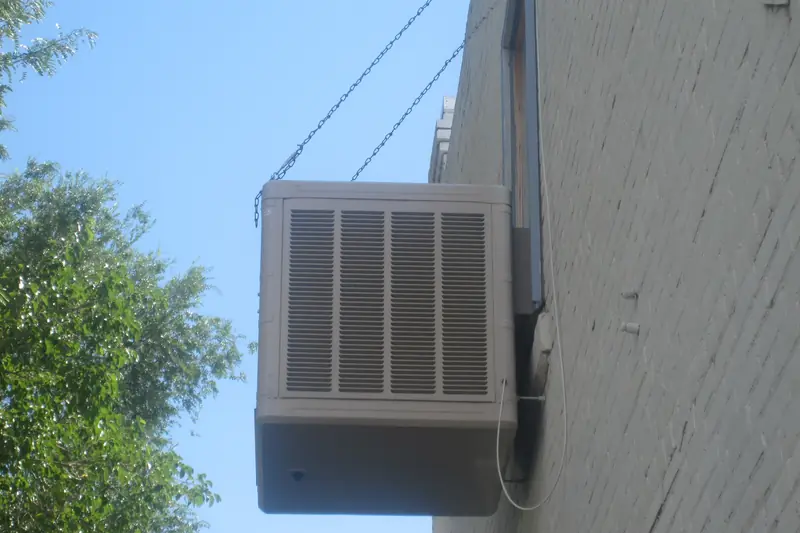
Points on this page
The forecast in brief
- A cooler cools by evaporation: each gallon of water evaporated takes about 8,700 Btu of sensible heat out of the air (Mississippi State Extension).
- University of Arizona Cooperative Extension says refrigerated air uses three to five times as much electricity as evaporative cooling (AZ9145).
- At 100°F and 10% relative humidity, PNNL's chart shows supply air near 73°F; at 95°F and 50%, only about 84°F (PNNL).
- PNNL's rule of thumb: areas with a design wet-bulb temperature of 70°F or lower suit evaporative cooling.
- A cooler needs an exit for its air: about 2 square feet of open relief per 1,000 CFM (PNNL, citing PG&E).
- Drain the pan if the cooler will sit idle more than a few days; standing water can grow bacteria, including Legionella (PNNL; UA).
How does a swamp cooler work?
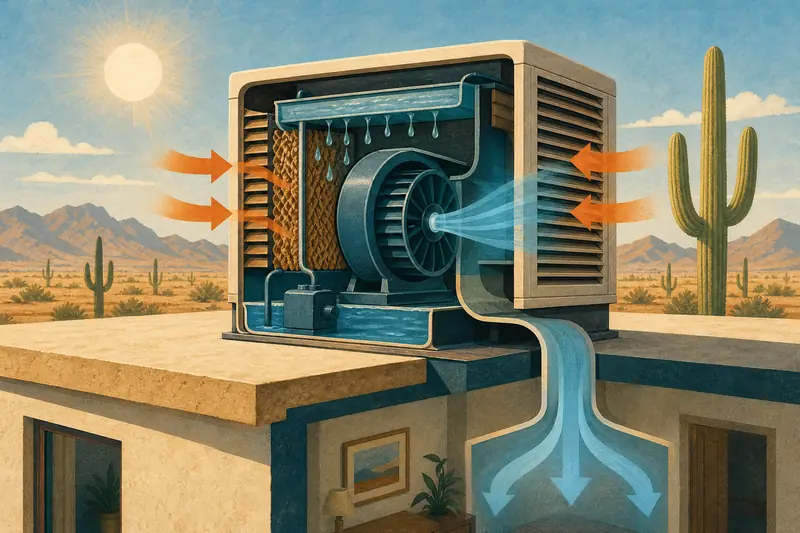
A swamp cooler pulls outside air through pads kept wet by a small pump, and the water that evaporates carries heat away, so cooler air blows into the house. The Arizona bulletin lists eight main parts: housing, blower, recirculating pump, reservoir, float valve, pads, water distribution lines and motor. Nothing in it compresses refrigerant, which is why the power draw is small.
The trade is moisture. Mississippi State Extension explains that the heat is not destroyed but changed into humidity, so the air comes in cooler and damper. PNNL adds that a running cooler replaces all the air in a house every 2 to 3 minutes, which keeps that added moisture moving out instead of piling up.
Swamp cooler vs air conditioner: which costs less to run?
The swamp cooler costs less to run on electricity, and the gap is wide. UA's bulletin gives yearly cooling energy for a 1,600 sq ft home of about 6,000 kWh with refrigeration and 1,500 kWh with an evaporative cooler, and puts the electricity ratio at three to five times. Those are 1994 figures; multiply by your own rate for a rough comparison and expect your house to differ.
Water is the cost an A/C does not have. UA's Phoenix study averaged 7.6 gallons per operating hour, which you pay for on the water bill; the water and scale page breaks that down. Low speed helps both bills: UA says it moves about 66% of high-speed airflow for about 30% of the energy.
How cool can a swamp cooler get?
A swamp cooler can bring air close to, but never below, the outdoor wet-bulb temperature, the coldest reading evaporation alone can reach. PNNL rates coolers by "cooling effectiveness", how close the supply air gets to that wet-bulb number, and says newer thick-pad units reach 75% to 93%. Its worked example: with 105°F outside air, a 60°F wet bulb and 90% effective media, the air leaving the cooler should be about 64.5°F.
Real days are less tidy. On PNNL's chart for an aspen-pad cooler, 100°F air at 10% relative humidity comes out near 73°F, a 27°F drop, while 95°F air at 50% humidity comes out near 84°F, only 11°F cooler. Moving air adds comfort on top: UA notes that 82°F can feel like 75°F in a moderate breeze.
When should a swamp cooler give way to the air conditioner?
Switch from the cooler to refrigerated air when outdoor humidity rises enough that the supply air stops feeling cool, which in Arizona usually means the monsoon. PNNL compares design days: Phoenix at 108°F with a 70°F wet bulb leaves a 38°F gap to work with, while Sarasota, Florida, at 92°F and a 79°F wet bulb leaves just 13°F. That is why coolers are a desert tool and a poor fit for the humid Gulf Coast, where muggy air also pushes the NWS heat index far above the thermometer reading. If a cooler can't keep a room below 90°F, a fan won't rescue it either: the CDC says fans fall short past that point.
UA says many Arizona homes keep both systems and run A/C through the sticky weeks. Do not run them together to pre-cool the A/C's intake: UA warns that the cooler's moisture condenses on the refrigerant coil and raises electric costs. If your system shares ducts, dampers must separate the two, and UA says to check them every year.
What size swamp cooler does a house need?
Coolers are sized by airflow in cubic feet per minute (CFM), not tons. UA's quick formula multiplies floor area by ceiling height and divides by two: a 1,600 sq ft home with 8-foot ceilings has 12,800 cubic feet, so look for a cooler near 6,400 CFM.
PNNL uses air changes per hour instead: house volume times 20 to 40 air changes, divided by 60. Its example, a 2,000 sq ft home with 8-foot ceilings at 20 air changes, works out to about 5,333 CFM, and it says common units run 3,000 to 6,500 CFM. UA adds that coolers that are too large or too small waste both water and energy, so ask the supplier to show the math for your climate.
What do swamp coolers need to run well?
A cooler needs open relief for its air, wet pads, a clean pan and regular checks. PNNL calls for about 2 square feet of unrestricted relief per 1,000 CFM, through partly open windows or ceiling vents into a vented attic; the attic ventilation page covers the vent side. UA suggests running the pump to soak the pads before the fan starts, so the house does not get a blast of dry, dusty air.
For upkeep, UA says inspect monthly during the season, and PNNL says service at least twice a year: pads and belt in spring, then drain, clean and cover the unit for winter. Work only with power off at the switch or breaker and the water supply valve closed, and read the owner's manual first. Rooftop units mean ladders, roof edges and live wiring, and many owners hire that work out; PNNL notes that ground- and wall-mounted coolers are easier to reach and cannot leak through the roof. If you're unsure, call a licensed technician.
During a cool spell, UA notes you can run the fan with dry pads to pull in night air without using water, the same idea as night flushing. In the hottest hours, keep an eye on people as well as the thermostat; the heat safety section covers the warning signs.
| Factor | Evaporative (swamp) cooler | Central air conditioner |
|---|---|---|
| Electricity | About 1,500 kWh a year, 1,600 sq ft home (UA) | About 6,000 kWh a year, same home (UA) |
| Water on site | 7.6 gal per operating hour, Phoenix average (UA) | Practically none (UA) |
| Indoor humidity | Raises it (PNNL) | Lowers it |
| Air supply | Fresh outside air, needs open relief (PNNL) | Recirculates house air |
| Best climate | Design wet bulb 70°F or lower (PNNL) | Any |
Cooler numbers
- 8,700 Btusensible heat removed per gallon evaporatedMississippi State Extension
- 75–93%cooling effectiveness of newer thick-pad coolersPNNL Building America Solution Center
- 3–5xelectricity refrigerated air uses compared with a coolerUA Cooperative Extension AZ9145 (1994)
- 30%energy at low speed for about 66% of the airflowUA Cooperative Extension AZ9145 (1994)
How this page was put together
Figures here come from PNNL's online resource guide on evaporative cooling systems, University of Arizona Cooperative Extension bulletin AZ9145 (1991, revised 1994; handle 10150/146414) and Mississippi State Extension publication P2774, read in October 2026. DOE Energy Saver's evaporative cooler page was offline, so its install-cost and energy estimates are not used, and no price figures appear because the bulletin's 1994 dollars no longer apply.
More questions
Can a swamp cooler replace central air in Phoenix?
For most of the dry season it can carry the load, but UA notes that coolers struggle during the monsoon. Many Phoenix homes keep refrigerated air for those weeks.
Why does my swamp cooler make the house smell musty?
Stale water or dirty pads are the usual cause. PNNL says to drain the pan when the cooler will sit idle more than a few days and to replace or clean the media each spring.
Do two-speed coolers save much?
UA says low speed gives about 66% of the airflow for about 30% of the energy. Use low at night or on milder days and high when you need a fast pull-down.
Is a swamp cooler any use in Houston or Miami?
Rarely well. Wet-bulb temperatures there sit far above PNNL's 70°F rule of thumb, so the air cannot take on enough water to cool much.
What is an indirect evaporative cooler?
It cools through a heat exchanger so the supply air does not pick up moisture. PNNL describes the design as using two separate air paths.
Can I use a thermostat with an evaporative cooler?
Yes. UA describes thermostats that start the cooler at a set indoor temperature, such as 80°F, and two-function controls that wet the pads before the fan starts.
Back to every section of the almanac