Ceiling Fan Direction in Summer
Short answer
Ceiling fan direction for summer is counterclockwise as you look up, so the blades push air straight down; that breeze lets you set the thermostat about 4°F higher without feeling warmer.
Swelter Almanac, checked against the sources · updated
Points on this page
The forecast in brief
- ENERGY STAR says to run a ceiling fan counterclockwise in summer; standing under it, you should feel a breeze.
- The DOE Energy Saver Guide (2022) says a fan lets you raise the thermostat about 4°F with no loss of comfort.
- FSEC modeled about 14% net cooling savings in Florida from fans plus a 2°F higher setpoint.
- Leave the thermostat alone and cooling energy may rise 15%, because fan motors add heat (FSEC).
- ENERGY STAR certified ceiling fans are up to 44% more efficient than conventional models.
- Above 90°F indoors, the CDC says fans can raise body temperature; find air conditioning instead.
A ceiling fan is the cheapest cooling appliance in most houses, and the one most often running for an audience of none. Getting it right takes three things: the right spin, a thermostat moved up to match, and a hand on the switch when you leave the room.
Which way should a ceiling fan turn in summer?
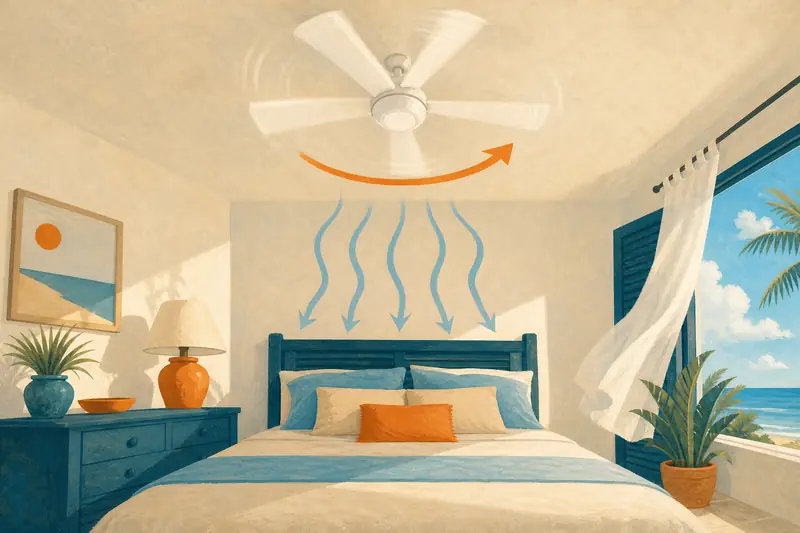
In summer a ceiling fan should turn counterclockwise when you stand under it and look up. ENERGY STAR's installation and use tips give the check: standing directly beneath the fan, you should feel a cool breeze on your face and shoulders.
If you feel almost nothing, the fan is probably spinning clockwise and drawing air up toward the ceiling. That is the winter setting, which ENERGY STAR pairs with low speed to push warm air gently down the walls. In July it just stirs the hottest layer of air in the room.
How do you change ceiling fan direction?
Most ceiling fans change direction with a small slide switch on the motor housing, and newer ones do it from a remote or wall control. Turn the fan off at its switch and wait for the blades to stop completely before you reach up, then flip the switch and restart it on medium or high.
Use a stable step ladder, not a chair, and keep your hands clear of the blades. If the switch is stiff or the fan wobbles badly after the change, check the blade screws and the manual before running it again.
Installing or moving a fan is a different job. ENERGY STAR notes that ceiling fans can weigh as much as 50 pounds and should hang from a ceiling box rated for fan support, and new wiring means shutting off the circuit at the breaker first and is a job for a licensed electrician. If you're unsure, call a licensed technician.
How much does a ceiling fan let you raise the thermostat?
A ceiling fan lets you raise the thermostat about 4°F with no loss of comfort, according to the DOE Energy Saver Guide. DOE's text on the South Carolina energy office mirror says the same, and ENERGY STAR reminds you that the energy and dollar savings depend on that adjustment.
How much that is worth depends on climate and house. FSEC's ceiling fan study modeled Florida homes and estimated that fans combined with a 2°F higher setpoint gave about 14% net savings a year.
The same study carries a warning. Metered data from 400 Florida households showed no cooling savings from ceiling fans, because people ran the fans and left the thermostat where it was. If 76°F is your usual summer setting, try 78°F with fans on in the rooms you are using, then 80°F, and stop where comfort ends. ENERGY STAR treats 78°F as a starting point for summer when you are home; the thermostat settings page covers the rest of the schedule.
Do fans cool a room or only people?
Fans cool only people. ENERGY STAR explains that the airflow creates a wind-chill effect on skin, and says ceiling fans cool people, not rooms, so an unoccupied room should have its fan off.
A thermometer in the room will read the same with the fan on or off, or a touch higher, because every watt the motor and any light kit draw ends up as heat in the room. FSEC's analysis put a number on that: run fans without changing the thermostat and cooling energy use may rise by 15%.
So the habit is simple. Fan on when you walk in, fan off when you walk out, and leave the fans in bedrooms off until bedtime.
How much electricity does a ceiling fan use?
A typical ceiling fan draws 50–150 W on high speed, according to FSEC's 1996 analysis, and less on lower speeds. A central air conditioner draws far more, which is why trading a few degrees of thermostat setting for a fan's breeze pays off.
Efficiency varies by model. ENERGY STAR rates fans in cubic feet per minute per watt (CFM/W), weighted across speeds and standby, and says certified ceiling fans are up to 44% more efficient than conventional fans. Older DOE text gives a lower average figure of about 20%; the two numbers measure different things, a maximum and an average.
| Situation | Direction | Speed | Thermostat |
|---|---|---|---|
| Summer, room in use | Counterclockwise | Medium to high | Raise about 4°F (DOE) |
| Summer, room empty | Fan off | Off | No change |
| Winter, room in use | Clockwise | Low | Per heating schedule |
| Above 90°F indoors | Do not rely on fans | Not the main cooling | Move to air conditioning |
Ceiling fans by the numbers
- 4°FThermostat raise with a ceiling fan, no comfort lossDOE Energy Saver Guide
- 14%Net cooling savings with fans plus 2°F higher setpointFSEC
- 15%Possible rise in cooling energy if the setpoint is unchangedFSEC
- 44%Efficiency edge of ENERGY STAR fans, up toENERGY STAR
When do fans stop helping?
Fans stop helping when the indoor air passes 90°F. The CDC says to use fans only when indoor temperatures are below 90°F, because above that a fan can increase body temperature; air that hot is warming your skin, not cooling it.
The National Weather Service adds that you should not point a portable fan at yourself when the room is hotter than 90°F. If the A/C fails in a heat wave, go somewhere air-conditioned, and dial 2-1-1 to find a cooling center. The heat safety section lists the warning signs of heat illness, and what to do when the A/C quits covers the first hour.
Ceiling fans also cannot fix humidity. In a sticky Gulf Coast house, a breeze helps, but the real comfort problem may be moisture, which the humid heat section deals with. The Moving air hub compares fans with whole-house ventilation.
How this page was put together
This page is based on ENERGY STAR's ceiling fan installation and use tips, product page and key product criteria; the DOE Energy Saver Guide (2022) and DOE text on the South Carolina Office of Regulatory Staff mirror; FSEC's 1996 analysis of ceiling fans in Florida homes; and the CDC and National Weather Service heat pages, all read in October 2026. A fan-sizing table by room size was left out because no primary source with one could be read, and so were blade-pitch and brand comparisons.
More questions
Is counterclockwise always the summer setting?
For nearly all fans sold in the US, yes, viewed from below. If a fan's manual says otherwise, trust the breeze test: in summer you should feel air moving down onto you.
Should a ceiling fan run all night?
Only while someone is sleeping under it and the room is below 90°F. A fan in an empty guest room does nothing but use power and add a little heat.
Do ceiling fans help in humid weather?
They make sticky air feel more bearable by moving it across damp skin. They do not remove moisture, so keep the A/C fan on AUTO and see the humid heat pages if the house feels clammy.
Can a ceiling fan replace air conditioning?
In mild weather, sometimes. During a heat wave, no: above 90°F indoors the CDC says a fan can raise body temperature, so go to air conditioning instead.
What speed should the fan run in summer?
Medium or high when you are in the room, since the cooling comes from air speed across your skin. Low speed is the winter setting, used with clockwise rotation.
Do bigger fans cool better?
A larger fan moves more air at a lower speed, but there is no primary sizing table to point to. Compare models by their CFM/W efficiency rating on the ENERGY STAR label instead.
Does reversing direction wear out the motor?
Reversible fans are meant to run both ways, and changing the switch with the blades stopped is the normal method. Never flip it while the blades are turning.
More on moving air
Back to every section of the almanac