Swamp Cooler Water, Scale and Pads
Short answer
Swamp cooler water use averaged 7.6 gallons per operating hour in a Phoenix field study, and the hardness of that water decides how much you bleed off, how fast scale forms and how long pads last.
Swelter Almanac, checked against the sources · updated
This page links to SoftPro Water Systems, owned by the people who run Swelter Almanac. Those links are examples only; no figure here depends on them. About these links
Points on this page
The forecast in brief
- Phoenix coolers averaged 4.4 gallons per operating hour without bleed-off and 10.4 gallons with it (University of Arizona Cooperative Extension, AZ9145).
- Bleed-off systems in that study used about 8,650 gallons over a cooling season (UA, 1994).
- A separate Lawrence Berkeley National Laboratory review found about 400 liters, roughly 106 gallons, per household per day (LBNL).
- UA suggests bleeding off about one-third of the makeup water, less if no scale forms on the pads.
- The same bulletin says sodium from softened water piles up on pads and in the reservoir, so softened water is a poor fit for coolers.
- Aspen-fiber pads last one cooling season; thick rigid pads are built to last several years (UA).
How much water does a swamp cooler use?
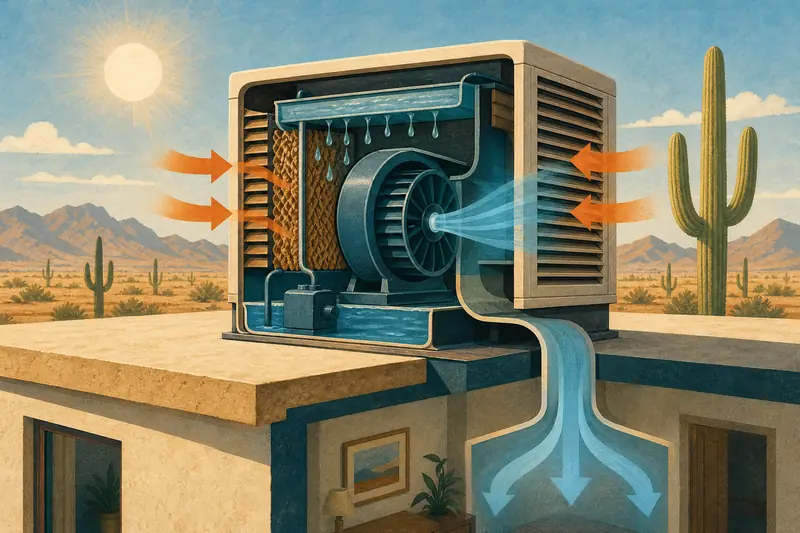
A swamp cooler typically uses several gallons for every hour it runs, more with a bleed-off line and in drier, hotter air. The Phoenix study reported in the UA bulletin monitored coolers at 46 homes and averaged 7.6 gallons per operating hour: 4.4 gallons without bleed-off and 10.4 with it. Coolers with bleed-off used about 8,650 gallons across the season.
Other studies measure differently, so do not blend their numbers. The water has to go somewhere because evaporation is the whole mechanism: roughly 8,700 Btu of heat leaves with every gallon, by Mississippi State Extension's count. LBNL's review puts the average at about 400 liters (106 gallons) a day for each household, across US and Australian homes. PNNL's resource guide, citing a 2007 Southwest efficiency study, estimates yearly use for a 1,500 sq ft home without bleed-off at 2,980 gallons in Santa Fe, 7,261 in Albuquerque and 12,457 in Las Cruces, and says to add 50% with bleed-off (PNNL).
Why does mineral scale build up?
Scale builds because evaporation leaves the minerals behind: pure water leaves as vapor, and the calcium and other dissolved solids stay in the pan and on the pads. UA explains that scale on pads spreads water unevenly, causing hot spots and less cooling, and that the rust and corrosion from hard water may shorten a cooler's life by 50%. Concentrated salts that overflow can also damage a roof, the bulletin adds.
LBNL notes that alkalinity is high across much of the Southwest, so bleed water there adds a good deal to total use. Knowing your own number helps. A water test kit (SoftPro Water Systems, owned by the people who run Swelter Almanac) shows how hard your supply is, which tells you whether to lean toward a higher or lower bleed rate and how often to scrub the pan. It is a measuring step, not a reason to soften the cooler's water.
What is a bleed-off line?
A bleed-off line is a small tap on the recirculating line that sends part of the pump's water to a drain, so fresh makeup water dilutes the minerals left in the pan. UA reports bleed-off raises water use by an estimated 10% to 50%, and cites a University of Arizona water systems manager suggesting a rate of about one-third of makeup water, lowered if no scale shows on the pads. Illinois Extension gives the same direction for cooling pads: less bleed for low-hardness water, more for hard water.
Do not send bleed water to garden beds. UA says horticulture specialists discourage it because the concentrated minerals can damage or kill plants and seal clay soils; Bermuda grass and saltgrass tolerate it. PNNL describes an alternative, an auto-flush or dump pump that empties the pan and refills it every 8 to 12 hours of operation, as a more efficient way to control buildup.
Running on low speed cuts the water spent on evaporation, but UA notes the bleed rate stays the same, so a slow-running cooler with a fast bleed wastes a larger share.
Can you use softened water in a swamp cooler?
No: UA Cooperative Extension advises against it. The bulletin says the sodium added by softening accumulates on the pads and concentrates in the reservoir, and that softened water may increase pad maintenance and speed rusting of metal parts.
If your house has a whole-house softener, the cooler should be fed from an unsoftened (bypass) line or from whatever supply its maker specifies. Low-hardness water from the source is different from sodium-softened water; it simply needs less bleed-off. Scale-control additives exist, but UA warns that some cooler makers do not recommend them and that chemicals can blow into the house, so check with the maker first.
How often should you change the pads?
Aspen-fiber pads are meant to last one cooling season, while rigid cellulose and thick single-pad media are designed to last several years if the cooler is run per its manual, according to UA. The bulletin says cheaper spun aluminum and plastic pads may need changing several times in one season. PNNL puts pad replacement or cleaning on the spring start-up list.
Between changes, look for even wetting. UA says pads should be thoroughly and uniformly wet, because dry spots sharply cut cooling, and suggests a monthly inspection while the cooler runs, including belt tension and reservoir level. Hard crust, dry streaks or a sagging pad all mean it is time. Without a bleed-off line, UA suggests a thorough cleaning to remove scale at least once a season.
How do you keep swamp cooler water clean?
Keep the pan fresh by draining it whenever the cooler will sit unused for more than a few days. PNNL and UA both warn that standing water can grow bacteria, including the kind that causes Legionnaires' disease. UA says that after an idle stretch you can either drain the pan or treat the water with chlorine for at least 30 minutes before restarting.
At the end of the season, PNNL's routine is to shut off the water line, drain and clean the pan, and cover the cooler. Shut the power at the breaker or unit switch and close the supply valve before you touch anything. On a roof, the ladder and the wiring are the real hazards, and many owners hire it out. If you're unsure, call a licensed technician.
For the bigger choice of cooler or A/C, see swamp cooler vs air conditioner. The dry heat overview covers night air and shade, and if your home also runs central air, the A/C maintenance checklist covers that side. In the humid months, the humid heat section explains why moisture control takes over.
| Pad type | Expected life | Notes |
|---|---|---|
| Aspen-wood fiber | One cooling season | Low airflow resistance; may shed debris into the pan |
| Rigid cellulose media | Several seasons | Uniform media, recommended by some makers |
| Thick single-pad media | Several years, run per the manual | Costs more than aspen |
| Spun aluminum or plastic | May need changing several times a season | Cheaper up front |
Water by the gallon
- 4.4 gal/hrPhoenix coolers without bleed-offUA Cooperative Extension AZ9145 (1994)
- 10.4 gal/hrPhoenix coolers with bleed-offUA Cooperative Extension AZ9145 (1994)
- 8,650 galper cooling season, bleed-off systemsUA Cooperative Extension AZ9145 (1994)
- 106 galper household per day, US and Australia averageLawrence Berkeley National Laboratory
- 10–50%extra water use from bleed-off valvesUA Cooperative Extension AZ9145 (1994)
How this page was put together
Built from the Arizona Cooperative Extension water-use bulletin AZ9145 (1994 revision, handle 10150/146414), Lawrence Berkeley National Laboratory's review of evaporative cooler water use, PNNL's evaporative cooling resource guide and Illinois Extension's cooling-pad page, read in October 2026. Each study's water figure is kept with its own unit because they measured different things. DOE Energy Saver's water estimates were offline and are left out.
More questions
How do I measure my own cooler's water use?
Read the water meter before and after a few hours with nothing else running, then divide by the hours. Compare with UA's Phoenix averages of 4.4 and 10.4 gallons per hour.
Is the white crust on my pads harmful?
It is mineral scale, and UA says it causes hot spots and less cooling. Replace crusted aspen pads and check whether your bleed rate is high enough for your water.
Can I water my lawn with bleed-off water?
UA says horticulture specialists discourage it because the concentrated minerals can damage plants and seal clay soil. Only salt-tolerant grasses such as Bermuda and saltgrass handle it.
What does a hardness test tell me about my cooler?
It tells you how much scale-forming mineral your water carries. Harder water needs more bleed-off and more frequent cleaning; softer source water needs less.
Should I add chlorine to my cooler all summer?
UA describes chlorine as a step after an idle period, run for at least 30 minutes before restarting. Draining an idle pan is the simpler option, and some makers restrict additives.
Does a cooler use water when the pads are dry?
No. On cool evenings, UA says the fan alone can pull in outside air over dry pads, and that uses no water at all.
Back to every section of the almanac